

A strategic sector in transition
French agriculture holds a major position on the international stage, ranking as the world’s fifth-largest exporter and Europe’s third-largest exporter. Yet the sector is facing growing dependence on imports, particularly for fertilisers, fossil energy and animal feed. Inheriting a production model modernised after the Second World War—based on mechanisation, the use of inputs, and animal and plant breeding—the French agricultural system is now continuing its transformation by gradually integrating innovations at every stage of production, in a drive for continuous optimisation.
In this context, the French Court of Auditors published a report in February 2025 devoted to innovation in agriculture, assessing the effectiveness of public policies put in place to accelerate the agroecological transition and strengthen the sector’s competitiveness. Between 2017 and 2024, excluding research and development, public support for agricultural innovation reached nearly €8.5 billion—more than €1 billion per year—distributed unevenly between farmers’ uptake of innovations (40%), their valorisation (29%), their dissemination (16%) and cross-cutting funding (15%) that may concern several segments of the innovation process. The Court’s analysis is based in particular on a survey of 1,005 farm managers, identifying the levers, obstacles and recommendations to strengthen the impact of public policies in a rapidly changing sector.
A gradual but uneven adoption of innovations
Adoption rates and types of innovations
The first chapter of the report shows that innovation is now widespread in French agriculture, as 86% of the farmers surveyed adopted at least one innovation over the 2023–2024 period. This innovation dynamic is nonetheless gradual: farmers favour incremental changes that improve what already exists—such as new seeds, higher-performance farm equipment or alternative cropping methods—rather than radical upheavals to their organisation.
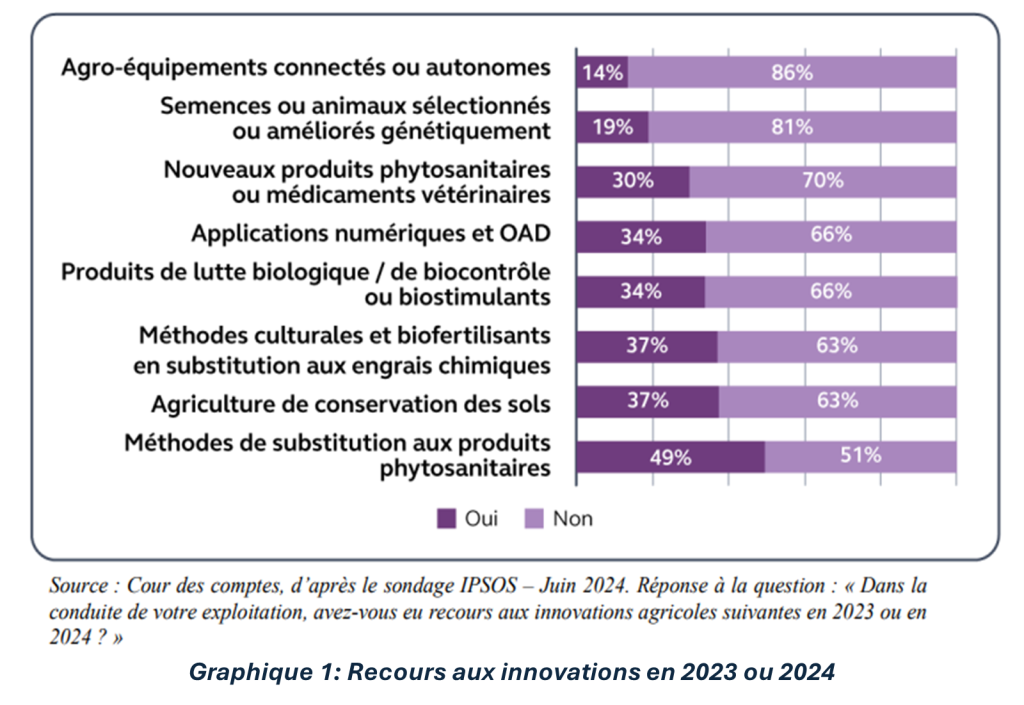
Chart No. 1 shows that, among the various innovative practices adopted by farmers, nearly 50% of respondents use methods that substitute for plant protection products, while 37% favour soil conservation. Conversely, adoption of the most recent technologies, such as connected agri-equipment, remains marginal, with only 14% of farmers concerned.
Farmer profiles and expectations regarding innovation
The report also highlights that there is no typical profile of an innovative farmer: while the most highly educated farmers, those from an agricultural background, with good Internet access and engaged in quality schemes adopt more innovations, age is only a secondary factor, with younger farmers only slightly more inclined to integrate digital tools. Arable farming stands out for stronger adoption of Agritech, unlike mixed farming and mixed crop-livestock systems, which are less innovative, while specialised crops mainly favour ecological innovations.
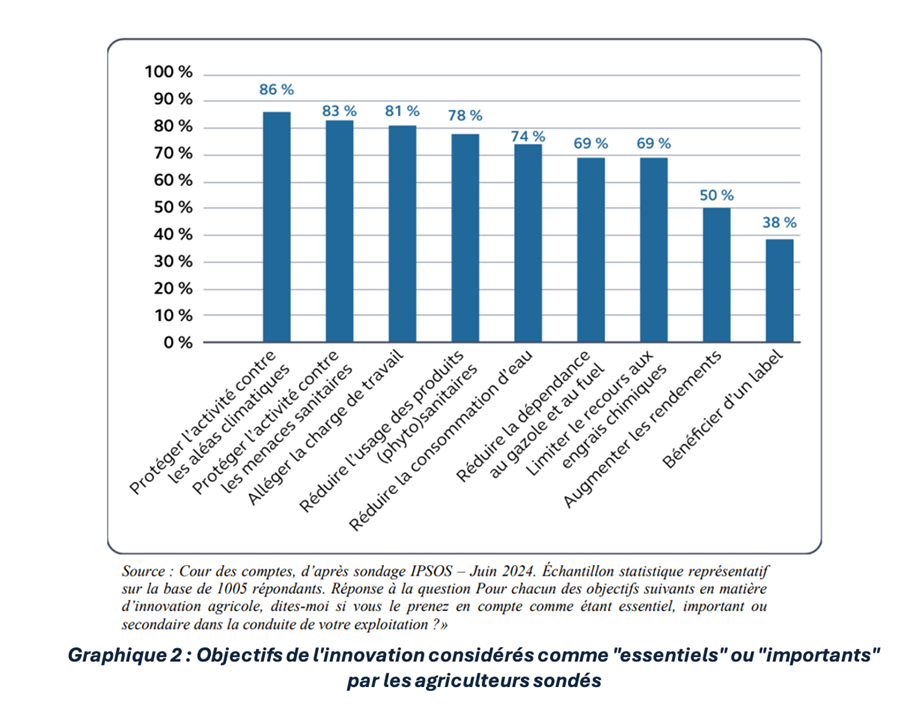
Chart No. 2 highlights the objectives assigned to precision agriculture, reflecting farmers’ main expectations regarding innovation. A majority consider protection against climatic (86%) and health-related (83%) hazards to be an “essential” or “important” objective, as is reducing workloads (81%). Reducing inputs is also a major issue: 78% of farmers see innovation as a way to limit the use of plant protection products. By contrast, only 50% see it as a lever to increase yields, a sign that productive performance is no longer the sole criterion for valuing new agricultural technologies.
Barriers to agricultural innovation in France
The main barriers to innovation remain financial: 71% of respondents cite the high upfront cost and an overly long return on investment as major obstacles. Added to this are structural barriers linked to the organisation of value chains, which favour standardised solutions to the detriment of more innovative alternative systems.
Thus, despite strong innovation momentum, farmers’ uptake of new developments has not yet reached the level needed to fully meet the ambitions of the agroecological transition and the third agricultural revolution.
Dissemination of innovations: findings and limitations
Budget weight and training challenges
The second chapter of the report analyses the effectiveness of public support for disseminating innovation among farmers and highlights its limitations. It shows that the innovation dissemination segment remains the least supported by public policy, with only 16% of total funding allocated to this area.
Training, although improving, is not managing to cover the growing diversity of agricultural profiles, notably because one third of new entrants have no agricultural training, and the skills required to do this job continue to broaden, now including management, marketing, digital skills and agronomy.
Continuing training, though essential to enable farmers to update their knowledge in a rapidly changing sector, remains insufficiently developed and supported by public authorities.
Information quality and the effectiveness of advisory services
Information is plentiful thanks to the diversification of digital channels and open data, but its quality remains uneven and data interoperability is problematic, limiting its circulation and uptake by farmers.
Knowledge transfer structures, such as experimental farms or agricultural technical institutes, play an important role in testing and validating innovations, but dissemination of their results can still be improved, notably due to limited human and financial resources.
Farmer collectives and national bodies with an agricultural and rural remit promote tailored support and the dissemination of good practices, but their impact remains limited at national level.
Advisory services, long considered the preferred vector for innovation, now suffer from a lack of coordination and differentiation, with a fragmented offer between chambers of agriculture, the private sector and cooperatives, which complicates access to appropriate support—particularly for farmers engaged in innovative or alternative approaches.
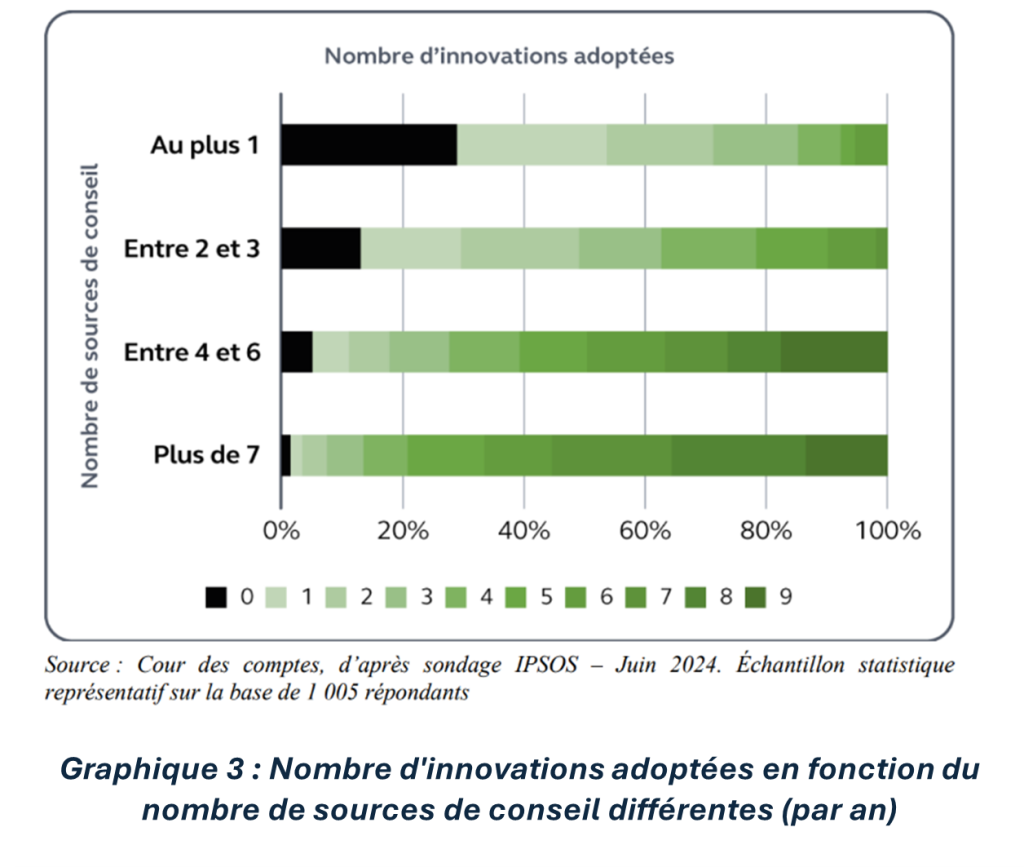
The analysis shows that the most innovative farmers are also those who seek advice the most and diversify their sources, but nearly one third of farmers receive little support, which slows the adoption of new practices.
On this point, the report’s Chart No. 3 clearly illustrates the correlation between farmers’ degree of innovation and the diversity of advisory sources used, showing that the more innovative a farmer is, the more they draw on different types of advice.
A public strategy that is still incomplete
Lastly, the report stresses that public policy lacks a clear strategy to mobilise and bring along farmers who are furthest from innovation, and that particular effort should be focused on continuing training, information quality and access to independent, appropriate advice, in order to respond effectively to the needs of an agricultural sector undergoing profound transformation.
Valorisation and positioning of French Agritech
Support policy for valorisation
The third chapter of the report looks at the impact of public policies on the positioning of French Agritech throughout the valorisation chain. It highlights the diversity and scale of public support, ranging from long-standing funding for the agricultural sector to exceptional schemes designed to encourage risk-taking and the valorisation of innovations, notably through calls for projects or recovery plans.
This support benefits research, innovative companies, local authorities and, more indirectly, farmers, with a particularly central role for Bpifrance, which accounts for nearly half of the funds committed to valorisation, and for FranceAgriMer, which manages in particular more than €600 million in investment aid for agri-equipment over the recent period.
Results and international outlook
Thanks to this mobilisation, France is managing to maintain its standing in the Agritech sector, despite growing competition from emerging countries, particularly China.
France maintains a stable level of transfer from research to valorisation, with a rate of 3%, in line with its share of global GDP, and stands out for the growth in fundraising by its sector companies: in 2022, French Agritech start-ups raised more than €800 million, placing France 2nd in Europe behind Germany.
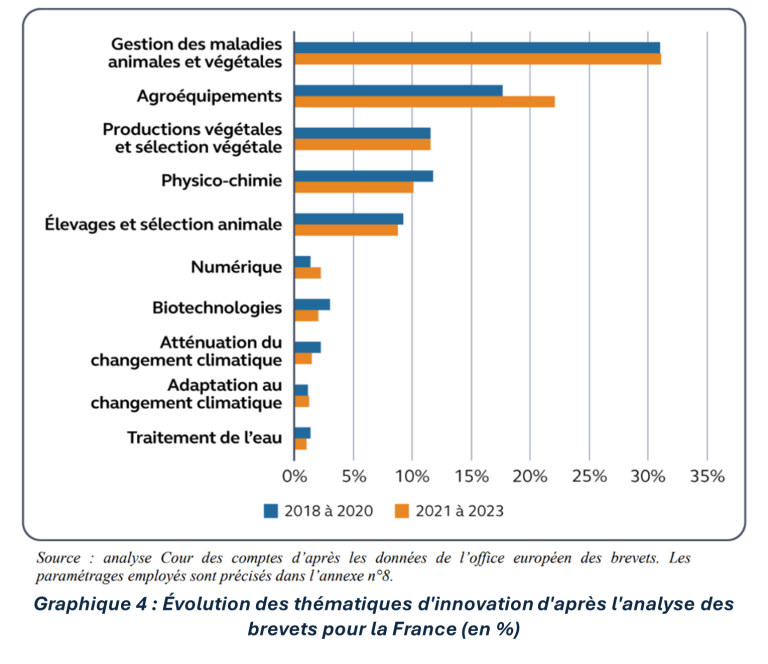
Innovation areas are varied, ranging from the management of animal and plant diseases to agri-equipment, plant breeding, physico-chemical processes and biotechnologies, with biocontrol gaining momentum.
The report’s Chart No. 4 illustrates the distribution of innovation themes, notably showing the growing share of biocontrol solutions and the momentum around digital and robotic technologies.
Structural obstacles to overcome
The French Agritech landscape is characterised by a diversified ecosystem, made up of large groups, cooperatives, start-ups and consortia structured around complementary themes, such as precision fertilisation, agricultural digital technologies, robotics or biocontrol.
However, several structural barriers persist and limit Agritech’s ability to scale up: access to experimentation remains difficult for innovative companies, coordination between infrastructures is insufficient, and time to market—particularly for plant protection products—is especially long (up to 7 years on average).
Added to this are shortcomings in the digital domain, with network coverage still incomplete for many farmers and a lack of interoperability between the different technological solutions, which complicates their uptake.
Despite these obstacles, public policy has helped support the emergence and valorisation of many innovations, while sharing the financial risk between start-ups, mature companies and investors.
Recommendations from the French Court of Auditors for 2025
The Court concludes that public policy has helped strengthen the competitiveness of French Agritech, but recommends stepping up efforts on several points:
Facilitate experimentation for innovative companies,
Support small organisations in regulatory procedures,
Strengthen continuing training and independent advisory services,
Improve digital coverage and solution interoperability,
Develop a targeted strategy to reach farmers who are still far from innovation.
Are you a cooperative, an Agritech company, an agri-food business or a committed farmer? Join the Fermes Leader momentum.

